


A single centimetre is the difference between an evening of effortless connection and a subtle, persistent discomfort that cuts a dinner party short. You've likely spent weeks selecting the perfect timber grain or marble slab, yet the technical specifications of dining table height often remain a source of quiet anxiety. It's a common concern when commissioning a bespoke piece for a modern Australian home. You want a table that anchors your open-plan space without feeling awkward or out of scale.
Discover how the precise height of your dining table influences both the comfort of your guests and the aesthetic presence of your home. We promise to demystify these ergonomic standards, giving you the confidence to specify custom dimensions that suit your lifestyle perfectly. This guide explores the critical relationship between seat clearance and tabletop thickness, providing a clear framework to ensure your dining area facilitates long, comfortable conversations. From understanding the 75cm benchmark to navigating the nuances of bespoke design, you'll learn how to create a sanctuary for shared moments.
Key Takeaways
- Understand why the 750mm to 760mm range is the established benchmark for Australian dining rooms and how it influences the overall flow of your space.
- Master the ergonomic equation by identifying the ideal dining table height relative to your chair seat to ensure effortless comfort for every guest.
- Learn to prioritise the "thigh gap"; this essential clearance between the seat and the table's apron is the key to preventing physical strain.
- Utilise the 90cm clearance rule to maintain spatial harmony and allow for unhindered movement within open-plan living environments.
- Gain the confidence to specify bespoke dimensions that cater to non-standard requirements, ensuring your furniture is as functional as it is beautiful.
The Silent Standard: Why Dining Table Height Dictates Room Presence
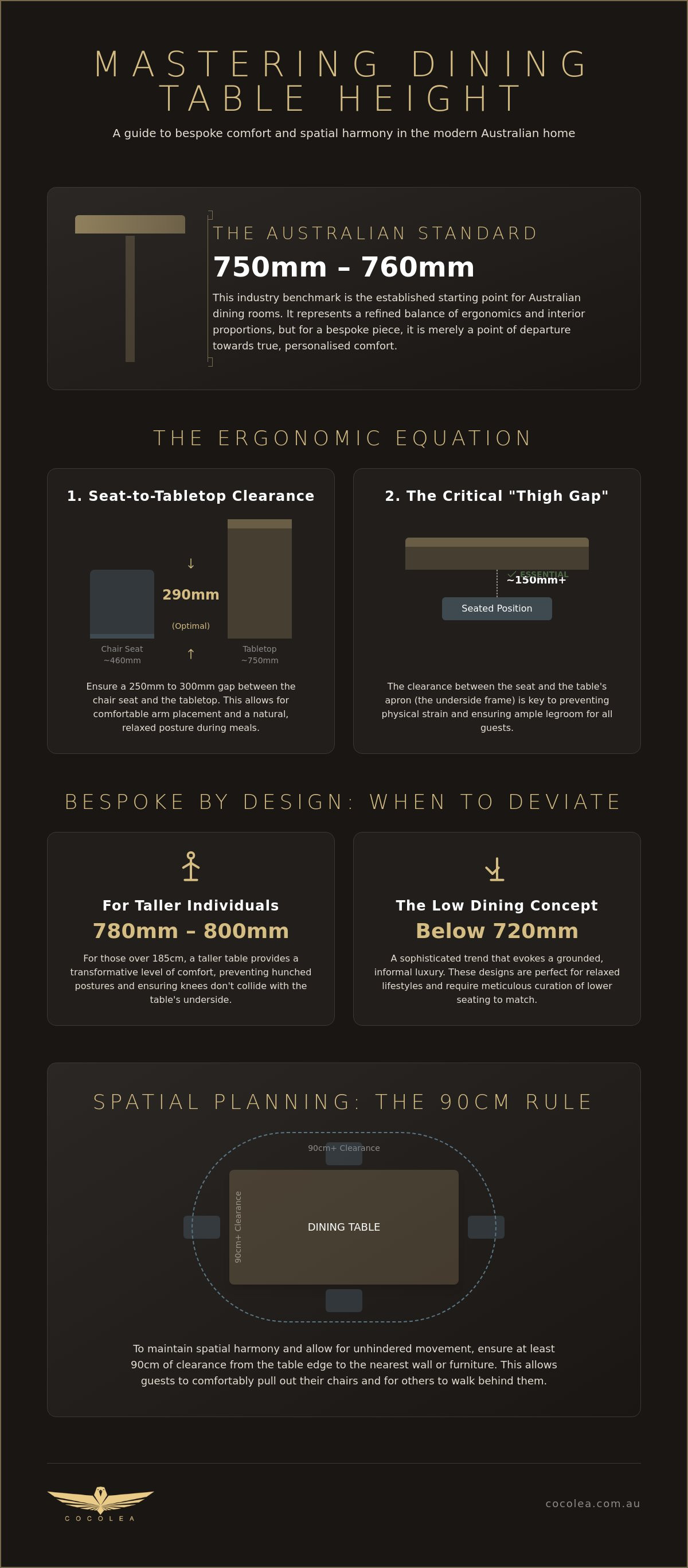
The architecture of a dining room relies on more than just the choice of timber or the sweep of a pedestal base. It's built upon a vertical foundation that most guests never consciously notice. In Australia, the industry recognises standard dining table heights as falling typically between 750mm and 760mm. This measurement isn't arbitrary. It represents a refined balance between human ergonomics and the physical proportions of a standard interior. However, for those commissioning a bespoke piece, this standard is merely a point of departure. True luxury lies in the ability to refine these dimensions to suit the specific needs of a household.
The Aesthetic Impact of Vertical Proportions
The verticality of a table influences its "visual weight" within a room. A lower profile often suggests a grounded, minimalist aesthetic, while a slightly taller commission can command a space with architectural authority. We must align the table's height with the ceiling height and the broader scale of the home. In a grand residence with four-metre ceilings, a standard table might appear lost. Precise vertical positioning ensures a statement piece doesn't just sit in a room but truly owns it. Customisation allows us to manipulate these proportions to create a sense of permanence and artistic intent.
Functionality Meets Form in the Dining Suite
A bespoke table must transition seamlessly from a quiet morning coffee to a catered evening gala. This versatility depends heavily on how the height accommodates different modes of service. For a white-glove dining experience, the dining table height must allow staff to serve with precision without the guest feeling crowded. In modern Australian homes, where the dining area often merges with the lounge, the table must also complement your living room furniture. It should act as a sophisticated bridge between the relaxation of a modular sofa and the structured elegance of a formal meal, maintaining a cohesive aesthetic across the entire open-plan floor.
Standard vs. Bespoke: Navigating the 75cm Benchmark
While the 75cm benchmark serves as an industry anchor, it's essentially a compromise designed for the "average" user. It's the safe middle ground. However, for the discerning homeowner, a safe middle ground rarely translates to an exceptional experience. In the world of high-end interiors, the dining table height should be as tailored as a Savile Row suit. If your household is taller than the statistical average, a standard table often leads to hunched postures and restricted legroom. A bespoke commission ignores these mass-market constraints. It prioritises the lived experience of the primary users above all else.
Cultural nuances also play a significant role in determining the ideal verticality of a piece. Some traditions favour a lower, more grounded communal experience that encourages a relaxed, lingering atmosphere. Others demand a more elevated, formal stance that reflects a sense of architectural grandeur. Many clients seek out expert advice on dining table selection only to find that off-the-shelf options cannot accommodate these specific cultural or physical requirements. Customisation allows these traditions to be woven into the very fabric of the furniture, ensuring the result is both functional and deeply personal.
When to Deviate from the Standard
For individuals over 185cm, a table height of 780mm or even 800mm provides a transformative level of comfort. It allows for natural arm placement and prevents the knees from colliding with the table's underside. We are also seeing a sophisticated rise in "low dining" concepts. These pieces evoke a sense of grounded, informal luxury that is perfect for the modern Australian lifestyle. Such designs require meticulous curation to ensure your sofa and dining area feel cohesive within a shared architectural space. When the heights are mismatched, the visual flow of an open-plan home is instantly disrupted.
The Role of Custom Manufacturing
Mass-market furniture is built for shipping efficiency, not for the individual. It's limited by standard factory jigs and container dimensions. Bespoke creation is a different journey entirely. It's a process of millimetre-perfect results. When you consult with a designer, you aren't just selecting a timber grain; you're defining a "comfort profile" unique to your household. This level of precision is the hallmark of a luxury atelier. If you're ready to move beyond the compromise of the showroom floor, exploring our bespoke dining services ensures every dimension of your commission is intentional and expertly handled.
The Ergonomic Equation: Calculating Clearance and Comfort
Precision is the hallmark of a high-end commission. While the aesthetic of a table may capture the eye, its success is ultimately measured by the comfort of those seated around it. This comfort relies on a delicate "Golden Ratio" between the chair seat and the tabletop. While many resources define a standard dining table height, they often neglect the vertical volume occupied by the table's structure itself. A truly bespoke approach considers the total anatomy of the furniture, ensuring that the final piece is as effortless to use as it is beautiful to behold.
The most critical measurement in this equation is the "thigh gap". This is the clearance between the top of the chair seat and the lowest point of the table's underside. If this gap is too narrow, guests will feel constricted; if it's too wide, the dining table height will feel disconnected from the seating, leading to poor posture. Achieving the perfect clearance requires a meticulous understanding of how your chosen materials and base design will occupy the vertical space.
Measuring for Chair Compatibility
A standard dining chair seat typically sits between 450mm and 480mm from the floor. To maintain an ergonomic posture, we generally aim for a 300mm clearance rule. This ensures enough room for movement and comfort during long, lingering conversations. However, this calculation becomes more complex when incorporating carver chairs. The armrests on a carver require additional vertical clearance to slide neatly under the table. Without this foresight, you risk damaging both the chair and the table edge, or worse, forcing guests to sit uncomfortably far from their plates.
Material Thickness and Structural Support
The choice of material fundamentally alters the ergonomic landscape. A 40mm solid timber top offers a different profile than a 60mm marble slab or a reinforced industrial design. As the thickness of the top increases, the dining table height must be adjusted to preserve the necessary legroom. Traditional designs often utilise an "apron" (a structural frame under the top) which can significantly restrict movement. In contrast, modern bespoke commissions often favour pedestal bases or slimline steel frames. These designs maximise legroom and allow for greater freedom of movement, ensuring that the structural integrity of the piece never comes at the expense of the guest's comfort. By selecting a base that prioritises open space, you create an environment that invites people to stay long after the final course has been served.
Spatial Planning: Integrating Height into Your Interior Design
Spatial harmony requires a meticulous approach to both horizontal clearance and vertical alignment. While the ergonomic comfort of the user is paramount, the piece must also coexist with the architectural boundaries of the home. We adhere to the 90cm rule as a non-negotiable minimum; this ensures a clear passage from the table edge to the nearest wall or obstruction. In more expansive residences, extending this to 120cm allows for a truly unhindered flow, particularly during large social gatherings where movement around the room is constant.
The dining table height acts as a visual anchor in this spatial narrative. It establishes a distinct "zone" within the vastness of a modern floor plan. By synchronising the table's elevation with your lighting choices, you create a cohesive focal point. Pendants should typically hang 75cm to 90cm above the tabletop, a measurement that must be recalculated if you've opted for a non-standard bespoke height. This layering of vertical elements ensures the dining area feels intentional rather than accidental.
The Open-Plan Challenge
In the context of the Australian open-plan lifestyle, the dining table is rarely a solitary object. It exists in a dialogue with kitchen islands, which usually sit at a 900mm work height, and modular lounges that prioritise a lower, more relaxed profile. Balancing these varying elevations is essential to prevent a "choppy" visual landscape. When selecting materials like Australian Messmate or bold marble, the table needs space to "breathe" visually. If the dining table height is poorly matched to the surrounding furniture, the room loses its sense of architectural rhythm.
When planning your kitchen and dining layout, it's easy to overlook technical details that lead to costly errors; read more about avoiding common DIY kitchen renovation mistakes in Australia to ensure a seamless result.
The Foundation Design Package
Navigating these complexities is a core component of our service. Through our Foundation Interior Design Package, we provide a structured journey of design refinement. We don't simply manufacture furniture; we curate environments. This process includes a deep material consultation to ensure the height and visual weight of your commission are perfectly balanced against your existing interior. The journey concludes with our professional white-glove installation, ensuring your piece is positioned with millimetre precision to maximise both flow and impact.
If you're ready to transform your space with a piece tailored to your home's unique proportions, contact our design consultants to begin your bespoke journey.
Commissioning the Perfect Fit: The Cocolea Bespoke Process
The transition from a conceptual desire to a physical masterpiece requires a steady hand and a visionary eye. At Cocolea, the journey begins with a complimentary 60 minute consultation, where we delve into the nuances of your lifestyle and architectural environment. This is where we move beyond the generic. We don't just ask about the number of seats; we explore how the dining table height will interact with your specific flooring and how the length will anchor your room's flow. It's a collaborative refinement of every dimension, ensuring that length, width, and material thickness are perfectly balanced for your home.
For those seeking a comprehensive transformation, our design refinement services provide a complete concept, ensuring every technical specification is considered with artistic intent. A curated piece is an investment in longevity. When a table is designed specifically for your life, it transcends the fleeting nature of mass market trends. It becomes a permanent fixture of your personal narrative, built with the precision of a luxury atelier. Our Foundation Interior Design Package offers a structured pathway to this result, guiding you through the complexities of custom manufacturing with professional oversight.
Curating Your Aesthetic
Your dining area should be a reflection of your unique perspective. Whether you're drawn to the polished aluminium of aviation inspired designs, the raw strength of industrial aesthetics, or the timeless warmth of bespoke timber, the final result is a one of a kind statement. We guide you through the selection of finishes that complement your vision. By manipulating the dining table height and surface thickness, we ensure the piece commands attention while remaining perfectly functional. This is where the meticulous project director meets the visionary artist to create something truly exceptional.
The Final Implementation
The journey concludes with our white glove installation process, a service designed to offer complete peace of mind. Our team ensures that your commission is positioned with absolute precision, perfectly aligned with your architectural lighting and spatial boundaries. We verify that the table sits level on your specific flooring, maintaining the ergonomic integrity we established during the design phase. This final step is the culmination of months of craftsmanship, resulting in a dining sanctuary that facilitates effortless connection and enduring comfort for years to come.
Elevate Your Dining Experience Through Precise Design
Mastering the vertical proportions of your home transforms a simple meal into a sophisticated event. We've explored how the ideal dining table height isn't a rigid industry standard but a bespoke variable tailored to your chair selection, physical stature, and the unique architectural scale of your room. By prioritising ergonomic clearance and intentional spatial planning, you ensure your dining area remains a sanctuary for connection rather than a source of subtle discomfort. These technical details are the silent foundations of a truly successful interior.
A bespoke commission represents an investment in permanence and personal expression. Through our end to end professional design refinement, we translate your aesthetic desires into a physical reality built for longevity. Our process handles every complex detail, from material consultation to meticulous white-glove installation, ensuring your piece sits with absolute precision within your home. You don't have to settle for the compromises of mass market furniture when a curated solution is within reach.
Commission your bespoke dining table with Cocolea today and begin the journey toward a perfectly calibrated home. Your vision, supported by our expert oversight, will result in a one of a kind statement that serves your lifestyle for decades to come.
Frequently Asked Questions
What is the standard dining table height in Australia?
The standard dining table height in Australia typically ranges between 750mm and 760mm from the floor to the tabletop surface. This benchmark is designed to accommodate the average adult and aligns with standard chair dimensions. While this serves as a reliable baseline, bespoke commissions often deviate from these figures to better suit the specific ergonomic needs of a household or the architectural scale of a residence.
How much legroom do I need under a dining table?
You should aim for a minimum of 300mm of vertical clearance between the chair seat and the underside of the table structure. This ensures adequate "thigh gap" for movement and comfort during long social gatherings. Horizontally, a clearance of 90cm to 120cm from the table edge to the nearest wall allows for unhindered movement and a sophisticated room flow.
Can I customise the height of a Cocolea dining table?
Yes, every Cocolea dining table can be refined to your precise vertical specifications. Our bespoke process allows you to adjust the dining table height to suit non-standard requirements, whether you're designing for taller individuals or seeking a lower, more grounded aesthetic. This level of curation ensures your furniture is a one of a kind statement that prioritises your personal comfort profile.
How does table top thickness affect the height I should choose?
Substantial material thickness, such as a 60mm marble slab or heavy timber, reduces the usable legroom underneath the piece. To maintain the necessary 300mm ergonomic clearance, the overall height of the table must be increased accordingly. Failing to account for the thickness of the top and the structural apron can result in a cramped seating experience that detracts from the luxury of the commission.
What is the ideal height for a counter-height dining table?
The ideal height for a counter-height dining table is between 890mm and 915mm. These pieces are designed to align with standard Australian kitchen island benches, creating a seamless visual transition in open-plan living areas. They offer a more casual, social elevation that's perfect for breakfast nooks or informal entertaining spaces where guests may alternate between standing and sitting.
How far should a pendant light be from the dining table top?
A pendant light should typically hang between 75cm and 90cm above the dining table top. This synchronisation ensures the light source provides intimate illumination without obstructing the eye level of your guests. If you've commissioned a non-standard dining table height, this measurement must be recalculated to maintain the architectural hierarchy and visual balance of the dining zone.
What chair height should I use for a 76cm tall table?
For a table that stands 76cm tall, a chair with a seat height of 450mm to 480mm provides the most ergonomic experience. This combination preserves the critical 300mm clearance required for comfort. When selecting seating, also consider the height of armrests on carver chairs, as they must slide neatly under the table edge to avoid damage and ensure guests can sit close to the surface.
Do round dining tables require different height considerations?
Round dining tables generally follow the same vertical benchmarks as rectangular designs, but they require unique considerations regarding the base structure. A central pedestal is often preferred as it maximises legroom and allows for flexible chair placement. Because round tables often act as a singular focal point, their height must be perfectly calibrated to the room's ceiling height to ensure they command the space effectively.